
Back to top
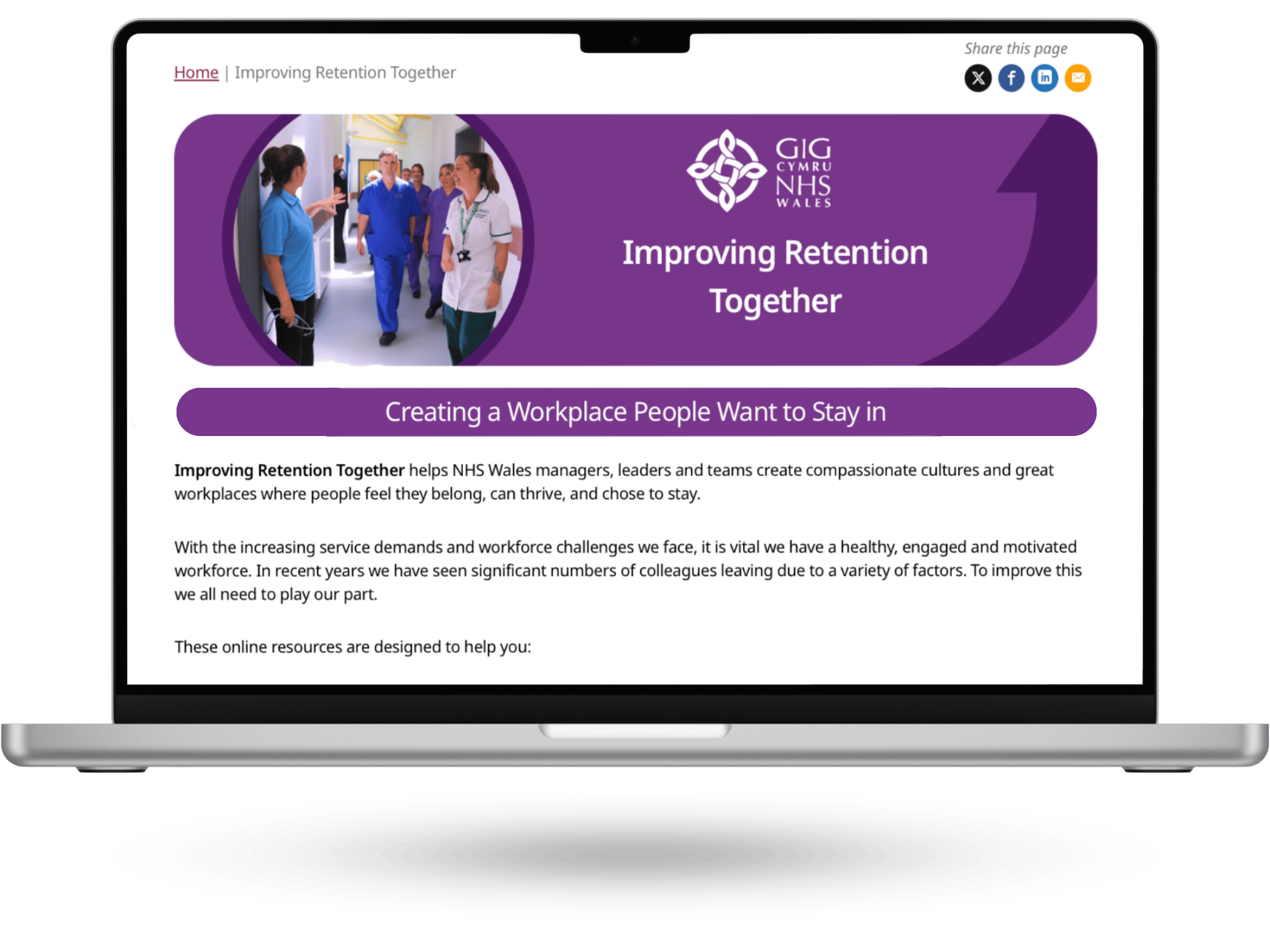
Product
- Improving Retention Together
Role
- UX Researcher
- UX Designer
- UI/Visual Designer
- Workshop Facilitator
Tools
- Canva
Empathise: Understanding the retention challenge
My team was requested to expand the existing National Retention Hub to include more detailed information on how to support staff to improve retention.
Before expanding the retention resources, I wanted to understand their purpose, the gaps they were intended to fill, and the needs of the staff using them.
To explore this, I led a face-to-face workshop with four National Retention Leads who had extensive experience working in clinical roles and supporting organisations to address retention challenges.
I conducted two exercises during the workshop utilising a digital whiteboard:
- Sailboat exercise - this collaborative activity helped identify what supports progress towards improving retention, as well as barriers and risks that may hinder it.
- Empathy map - this framework helped us organise what staff users think, feel, say, and do when addressing retention challenges, allowing us to better understand their experiences and needs.
These activities helped uncover key frustrations, behaviours, and motivations faced by staff working to improve retention in their teams.
Sailboat Exercise was used to find the goals, vision, risks and threats, the positive forces propelling the project forward and the things slowing it down
Ideating solutions based on the reflections made during the first part of the Sailboat Exercise
Empathy maps for two personas: Giles and Norma
Define: Turning insights into solutions
I then created a couple of tools to transform the workshops outcomes into insights and inform future stages of the product development.
- User personas - I developed two personas representing typical users of the hub to stir focus to real-user needs rather than assumptions.
- User needs and problem statements - key barriers identified during the workshops were translated into clear problem statements and associated user needs, providing a foundation to generating solutions.
User personas based on empathy maps
Key insights
- Staff are daily under intense time pressures and operational demands.
- Engagement depends on clear value, visible leadership support, and alignment with real frontline challenges.
- Access barriers to work desktops and poor platform content structure prevent users from finding relevant resources and knowing where to start.
- Different roles require tailored, low-friction experiences across mobile and desktop to support varied behaviours and motivations.
Ideate: Exploring practical retention solutions
Using the personas, user needs, and problem statements, I ran a workshop with my team to explore possible solutions that could support staff in improving retention while remaining realistic given the available resources.
User Needs
- Quick, actionable steps and easy to scan
- Accessible on mobile
- Practical examples
- Support independent action without relying on leadership
Problem Statements
- Lack time to engage with dense resources
- Lack of access to work desktops
- Struggle to translate theory into practical, achievable actions
- No access to self-directed resources
→
Proposed Solution 1
Modular Toolkit: a mobile-first toolkit with short, practical modules including step-by-step guidance, case studies, self-assessments, and printable resources.
User Needs
- Clear, jargon-free explanations of retention concepts
- Visual and verbal content over text-heavy materials
- Flexible learning that can be accessed across devices
Problem Statements
- Traditional training formats are too time-intensive
- Content is often overly academic and difficult to engage with
- Users disengage from resources that don’t feel immediately relevant
→
Proposed Solution 2
Micro Training Series: a series of short 10-minute videos addressing key topics related to improving retention.
User Needs
- Feel represented and understood through relatable stories
- See leadership engaged in order to build trust and credibility
- Clear communication that connects to everyday challenges
Problem Statements
- Lack of understanding and awareness of retention support and tools available
- Feeling unsupported and unseen by leadership
→
Proposed Solution 3
Awareness Campaign: a communication campaign using stories from frontline staff to raise awareness of retention challenges and solutions.
The stakeholders took on board all the suggestions proposed, with my team being responsible for the development of the modular toolkit and the other solutions picked up by the Communications Team.
Prototype: From concept to design
During the prototyping stage, two design approaches were explored.
Prototype 1: Modular Toolkit
I developed a high-fidelity prototype for a section of the toolkit using the platform’s built-in e-learning tool.
The prototype was designed as a non-linear, interactive learning guide that staff could utilise flexibly, with printable and downloadable information.
E-learning prototype of flexible working section of the Modular Toolkit
However, after presenting the prototype to stakeholders, two important considerations emerged:
- updating the existing hub webpages could deliver improvements faster - a key component due to project constraints
- presenting the content as webpages would feel more approachable and familiar to staff and less time-intensive than a course format
Based on this feedback, my team pivoted towards redesigning the existing webpages instead.
Prototype 2: Webpage Hub
I developed a mid-fidelity prototype of a set of webpages that contained essentially the same information as ‘prototype 1’, but with less conversational language and more concise.
Using the homepage as an example, I took the learning from the previous design stages and adapted the existing webpage content and design.
I simplified the homepage introduction, and brought the navigation closer to the top, making it more streamlined and focused.
Original homepage and prototyped homepage that integrates learning from the previous user-centred design phases
Test: Learning from users
To validate the design and content, I led usability testing with seven participants from different NHS Wales organisations.
Participants completed a series of tasks while thinking aloud, allowing researchers to observe how they navigated the hub and understood the information presented.
Testing showed that the hub provided a valuable and intuitive resource but with several areas for improvement.
Page of user testing report about the homepage
“It’s helpful with a few tweaks, here and there. It’s got all the information that you need.”
About the set of webpages
“[The webpages] may have assumed that I understand what flexible working means, but I don’t really know.”
About the Flexible Working webpage
Key insights
- Users perceived the hub as a centralised one-stop hub for all essential retention information.
- Design considered clean and easy to use
- Content assumes prior knowledge of retention concepts, causing confusion amongst participants
- Labelling unclear and inaccurate at times
- Idealistic tone of content considered to overlook real-world constraints of workforce
- Guidance was dense and wordy and lacked practical, real-world application
Iterate: From findings to final design
Based on the user testing findings, I refined the hub before launch by:
- Reframing the content with action-oriented narrative focused on practical steps
- Reorganising and relabelled key sections to create a more intuitive, user-led journey
- Simplifying language and structure to make content easier to understand and apply
Welsh Government had signed off the original submitted content before development began, which limited how many changes could be integrated such as simplifying the language and structure.
I utilise the homepage to provide examples of improvements integrated on the webpages.
→
Pain points
- Banner illustration has incorrect uniforms and users identified preference for real staff
- Tagline did not provide any additional relevant information
- Most of participants found the purpose of the webpages unclear.
- Navigation labels were considered unclear
- Page was considered too long due to eleven navigation button
→
Improvements integrated
- Banner illustration replaced with photo of real staff in correct uniforms
- Tagline and introductory text updated to clarity the purpose of the resources.
- Bullet points to clarify hub’s value and practical outcomes.
- Navigation buttons copy was improved to be more descriptive.
- Reduced size of navigation buttons
Outcome
- The final webpages were approved by the National Retention Lead for release.
- The webpages were launched in February 2026 with several improvements, making the hub clearer, more actionable, and easier for NHS staff to use independently.
Lessons learned
What worked
- The workshops during the empathise phase gave the project a strong foundation, building a clear understanding of the target audience, the problem, and the stakeholders' vision.
- Following each stage of the user-centred design process led to an iterative phase that required fewer changes and less time compared to other projects I've worked on where shortcuts were taken.
What didn’t go as expected
- Welsh Government had signed off the source document before the project began, which limited my control over pre-chosen illustrations and made it difficult to act on user testing insights around simplifying the content's language and structure.
- Not being able to move forward with Prototype 1 meant the final product was less flexible, less action-focused, and less tailored to user needs than intended.
What I learned
- Engaging stakeholders early and involving them in the user-centred design process can lead to a product more informed by genuine user needs, and less shaped by assumptions.
- Designing for both the target audience and human variability means the final product can benefit a wider range of people.
What I’d do differently next time
- Spend more time communicating the benefits and risks of proposed solutions early on, to reduce the chance of the project being redirected at a later stage.

Previous case study
Next case study



Empathise
Define
Ideate
Prototype
Test
Iterate
Back to top
Sharpening practical retention support for NHS Wales
Background: The ‘National Retention Hub’ is the NHS Wales digital resource on the Gwella platform that supports health and social care staff to improve retention in their teams and organisations through information and resources.
Goal: Expand the existing resources by applying a user-centred approach, shifting from dense academic content to practical, actionable guidance that enables NHS Wales staff to improve retention independently.
Solution: A redesigned, user-centred hub called ‘Improving Retention Together’, delivering a clear starting point to learn about the topic, with practical actionable steps.
Product
- Improving Retention Together
Role
- UX Researcher
- UX Designer
- UI/Visual Designer
- Workshop Facilitator
Tools
- Canva
Empathise: Understanding the retention challenge
My team was requested to expand the existing National Retention Hub to include more detailed information on how to support staff to improve retention.
Before expanding the retention resources, I wanted to understand their purpose, the gaps they were intended to fill, and the needs of the staff using them.
To explore this, I led a face-to-face workshop with four National Retention Leads who had extensive experience working in clinical roles and supporting organisations to address retention challenges.
I conducted two exercises during the workshop utilising a digital whiteboard:
- Sailboat exercise - this collaborative activity helped identify what supports progress towards improving retention, as well as barriers and risks that may hinder it.
- Empathy map - this framework helped us organise what staff users think, feel, say, and do when addressing retention challenges, allowing us to better understand their experiences and needs.
These activities helped uncover key frustrations, behaviours, and motivations faced by staff working to improve retention in their teams.
Sailboat Exercise was used to find the goals, vision, risks and threats, the positive forces propelling the project forward and the things slowing it down
Ideating solutions based on the reflections made during the first part of the Sailboat Exercise
Empathy maps for two personas: Giles and Norma
Define: Turning insights into solutions
I then created a couple of tools to transform the workshops outcomes into insights and inform future stages of the product development.
- User personas - I developed two personas representing typical users of the hub to stir focus to real-user needs rather than assumptions.
- User needs and problem statements - key barriers identified during the workshops were translated into clear problem statements and associated user needs, providing a foundation to generating solutions.
User personas based on empathy maps
Key insights
- Staff are daily under intense time pressures and operational demands.
- Engagement depends on clear value, visible leadership support, and alignment with real frontline challenges.
- Access barriers to work desktops and poor platform content structure prevent users from finding relevant resources and knowing where to start.
- Different roles require tailored, low-friction experiences across mobile and desktop to support varied behaviours and motivations.
Ideate: Exploring practical retention solutions
Using the personas, user needs, and problem statements, I ran a workshop with my team to explore possible solutions that could support staff in improving retention while remaining realistic given the available resources.
User Needs
Problem Statements
→
Proposed Solutions
- Quick, actionable steps and easy to scan
- Accessible on mobile
- Practical examples
- Support independent action without relying on leadership
- Lack time to engage with dense resources
- Lack of access to work desktops
- Struggle to translate theory into practical, achievable actions
- No access to self-directed resources
→
Modular Toolkit: a mobile-first toolkit with short, practical modules including step-by-step guidance, case studies, self-assessments, and printable resources.
- Clear, jargon-free explanations of retention concepts
- Visual and verbal content over text-heavy materials
- Flexible learning that can be accessed across devices
- Traditional training formats are too time-intensive
- Content is often overly academic and difficult to engage with
- Users disengage from resources that don’t feel immediately relevant
→
Micro Training Series: a series of short 10-minute videos addressing key topics related to improving retention.
- Feel represented and understood through relatable stories
- See leadership engaged in order to build trust and credibility
- Clear communication that connects to everyday challenges
- Lack of understanding and awareness of retention support and tools available
- Feeling unsupported and unseen by leadership
→
Awareness Campaign: a communication campaign using stories from frontline staff to raise awareness of retention challenges and solutions.
The stakeholders took on board all the suggestions proposed, with my team being responsible for the development of the modular toolkit and the other solutions picked up by the Communications Team.
Prototype: From concept to design
During the prototyping stage, two design approaches were explored.
Prototype 1: Modular Toolkit
I developed a high-fidelity prototype for a section of the toolkit using the platform’s built-in e-learning tool.
The prototype was designed as a non-linear, interactive learning guide that staff could utilise flexibly, with printable and downloadable information.
However, after presenting the prototype to stakeholders, two important considerations emerged:
- updating the existing hub webpages could deliver improvements faster - a key component due to project constraints
E-learning prototype of flexible working section of the Modular Toolkit
- presenting the content as webpages would feel more approachable and familiar to staff and less time-intensive than a course format
Based on this feedback, my team pivoted towards redesigning the existing webpages instead.
Prototype 2: Webpage Hub
I developed a mid-fidelity prototype of a set of webpages that contained essentially the same information as ‘prototype 1’, but with less conversational language and more concise.
Using the homepage as an example, I took the learning from the previous design stages and adapted the existing webpage content and design.
I simplified the homepage introduction, and brought the navigation closer to the top, making it more streamlined and focused.
Original homepage and prototyped homepage that integrates learning from the previous user-centred design phases
Test: Learning from users
To validate the design and content, I led usability testing with seven participants from different NHS Wales organisations.
Participants completed a series of tasks while thinking aloud, allowing researchers to observe how they navigated the hub and understood the information presented.
Testing showed that the hub provided a valuable and intuitive resource but with several areas for improvement.
“It’s helpful with a few tweaks, here and there.
It’s got all the information that you need.”
About the set of webpages
Page of user testing report about the homepage
“[The webpages] may have assumed that I understand what flexible working means,
but I don’t really know.”
About the Flexible Working webpage
Key insights
- Users perceived the hub as a centralised one-stop hub for all essential retention information.
- Design considered clean and easy to use
- Content assumes prior knowledge of retention concepts, causing confusion amongst participants
- Labelling unclear and inaccurate at times
- Idealistic tone of content considered to overlook real-world constraints of workforce
- Guidance was dense and wordy and lacked practical, real-world application
Iterate: From findings to final design
Based on the user testing findings, I refined the hub before launch by:
- Reframing the content with action-oriented narrative focused on practical steps
- Reorganising and relabelled key sections to create a more intuitive, user-led journey
- Simplifying language and structure to make content easier to understand and apply
Welsh Government had signed off the original submitted content before development began, which limited how many changes could be integrated such as simplifying the language and structure.
I utilise the homepage to provide examples of improvements integrated on the webpages.
→
→
Pain points
- Banner illustration has incorrect uniforms and users identified preference for real staff
- Tagline did not provide any additional relevant information
- Most of participants found the purpose of the webpages unclear.
- Navigation labels were considered unclear
- Page was considered too long due to eleven navigation button
Improvements integrated
- Banner illustration replaced with photo of real staff in correct uniforms
- Tagline and introductory text updated to clarity the purpose of the resources.
- Bullet points to clarify hub’s value and practical outcomes.
- Navigation buttons copy was improved to be more descriptive.
- Reduced size of navigation buttons
Outcome
- The final webpages were approved by the National Retention Lead for release.
- The webpages were launched in February 2026 with several improvements, making the hub clearer, more actionable, and easier for NHS staff to use independently.
Lessons learned
What worked
- The workshops during the empathise phase gave the project a strong foundation, building a clear understanding of the target audience, the problem, and the stakeholders' vision.
- Following each stage of the user-centred design process led to an iterative phase that required fewer changes and less time compared to other projects I've worked on where shortcuts were taken.
What didn’t go as expected
- Welsh Government had signed off the source document before the project began, which limited my control over pre-chosen illustrations and made it difficult to act on user testing insights around simplifying the content's language and structure.
- Not being able to move forward with Prototype 1 meant the final product was less flexible, less action-focused, and less tailored to user needs than intended.
What I learned
- Engaging stakeholders early and involving them in the user-centred design process can lead to a product more informed by genuine user needs, and less shaped by assumptions.
- Designing for both the target audience and human variability means the final product can benefit a wider range of people.
What I’d do differently next time
- Spend more time communicating the benefits and risks of proposed solutions early on, to reduce the chance of the project being redirected at a later stage.
Previous case study
Next case study
Empathise
Define
Ideate
Prototype
Test
Iterate
Back to top
Sharpening practical retention support for NHS Wales
Background: The ‘National Retention Hub’ is the NHS Wales digital resource on the Gwella platform that supports health and social care staff to improve retention in their teams and organisations through information and resources.
Goal: Expand the existing resources by applying a user-centred approach, shifting from dense academic content to practical, actionable guidance that enables NHS Wales staff to improve retention independently.
Solution: A redesigned, user-centred hub called ‘Improving Retention Together’, delivering a clear starting point to learn about the topic, with practical actionable steps.
Product
- Improving Retention Together
Role
- UX Researcher
- UX Designer
- UI/Visual Designer
- Workshop Facilitator
Tools
- Canva
Empathise: Understanding the retention challenge
My team was requested to expand the existing National Retention Hub to include more detailed information on how to support staff to improve retention.
Before expanding the retention resources, I wanted to understand their purpose, the gaps they were intended to fill, and the needs of the staff using them.
To explore this, I led a face-to-face workshop with four National Retention Leads who had extensive experience working in clinical roles and supporting organisations to address retention challenges.
I conducted two exercises during the workshop utilising a digital whiteboard:
- Sailboat exercise - this collaborative activity helped identify what supports progress towards improving retention, as well as barriers and risks that may hinder it.
- Empathy map - this framework helped us organise what staff users think, feel, say, and do when addressing retention challenges, allowing us to better understand their experiences and needs.
These activities helped uncover key frustrations, behaviours, and motivations faced by staff working to improve retention in their teams.
Sailboat Exercise was used to find the goals, vision, risks and threats, the positive forces propelling the project forward and the things slowing it down
Ideating solutions based on the reflections made during the first part of the Sailboat Exercise
Empathy maps for two personas: Giles and Norma
Define: Turning insights into solutions
I then created a couple of tools to transform the workshops outcomes into insights and inform future stages of the product development.
- User personas - I developed two personas representing typical users of the hub to stir focus to real-user needs rather than assumptions.
- User needs and problem statements - key barriers identified during the workshops were translated into clear problem statements and associated user needs, providing a foundation to generating solutions.
User personas based on empathy maps
Key insights
- Staff are daily under intense time pressures and operational demands.
- Engagement depends on clear value, visible leadership support, and alignment with real frontline challenges.
- Access barriers to work desktops and poor platform content structure prevent users from finding relevant resources and knowing where to start.
- Different roles require tailored, low-friction experiences across mobile and desktop to support varied behaviours and motivations.
Ideate: Exploring practical retention solutions
Using the personas, user needs, and problem statements, I ran a workshop with my team to explore possible solutions that could support staff in improving retention while remaining realistic given the available resources.
User Needs
Problem Statements
→
Proposed Solutions
- Quick, actionable steps and easy to scan
- Accessible on mobile
- Practical examples
- Support independent action without relying on leadership
- Lack time to engage with dense resources
- Lack of access to work desktops
- Struggle to translate theory into practical, achievable actions
- No access to self-directed resources
→
Modular Toolkit: a mobile-first toolkit with short, practical modules including step-by-step guidance, case studies, self-assessments, and printable resources.
- Clear, jargon-free explanations of retention concepts
- Visual and verbal content over text-heavy materials
- Flexible learning that can be accessed across devices
- Traditional training formats are too time-intensive
- Content is often overly academic and difficult to engage with
- Users disengage from resources that don’t feel immediately relevant
→
Micro Training Series: a series of short 10-minute videos addressing key topics related to improving retention.
- Feel represented and understood through relatable stories
- See leadership engaged in order to build trust and credibility
- Clear communication that connects to everyday challenges
- Lack of understanding and awareness of retention support and tools available
- Feeling unsupported and unseen by leadership
→
Awareness Campaign: a communication campaign using stories from frontline staff to raise awareness of retention challenges and solutions.
The stakeholders took on board all the suggestions proposed, with my team being responsible for the development of the modular toolkit and the other solutions picked up by the Communications Team.
Prototype: From concept to design
During the prototyping stage, two design approaches were explored.
Prototype 1: Modular Toolkit
I developed a high-fidelity prototype for a section of the toolkit using the platform’s built-in e-learning tool.
The prototype was designed as a non-linear, interactive learning guide that staff could utilise flexibly, with printable and downloadable information.
However, after presenting the prototype to stakeholders, two important considerations emerged:
- updating the existing hub webpages could deliver improvements faster - a key component due to project constraints
E-learning prototype of flexible working section of the Modular Toolkit
- presenting the content as webpages would feel more approachable and familiar to staff and less time-intensive than a course format
Based on this feedback, my team pivoted towards redesigning the existing webpages instead.
Prototype 2: Webpage Hub
I developed a mid-fidelity prototype of a set of webpages that contained essentially the same information as ‘prototype 1’, but with less conversational language and more concise.
Using the homepage as an example, I took the learning from the previous design stages and adapted the existing webpage content and design.
I simplified the homepage introduction, and brought the navigation closer to the top, making it more streamlined and focused.
Original homepage and prototyped homepage that integrates learning from the previous user-centred design phases
Test: Learning from users
To validate the design and content, I led usability testing with seven participants from different NHS Wales organisations.
Participants completed a series of tasks while thinking aloud, allowing researchers to observe how they navigated the hub and understood the information presented.
Testing showed that the hub provided a valuable and intuitive resource but with several areas for improvement.
“It’s helpful with a few tweaks, here and there.
It’s got all the information that you need.”
About the set of webpages
Page of user testing report about the homepage
“It may have assumed that I understand what flexible working means,
but I don’t really know.”
About the Flexible Working webpage
Key insights
- Users perceived the hub as a centralised one-stop hub for all essential retention information.
- Design considered clean and easy to use
- Content assumes prior knowledge of retention concepts, causing confusion amongst participants
- Labelling unclear and inaccurate at times
- Idealistic tone of content considered to overlook real-world constraints of workforce
- Guidance was dense and wordy and lacked practical, real-world application
Iterate: From findings to final design
Based on the user testing findings, I refined the hub before launch by:
- Reframing the content with action-oriented narrative focused on practical steps
- Reorganising and relabelled key sections to create a more intuitive, user-led journey
- Simplifying language and structure to make content easier to understand and apply
Welsh Government had signed off the original submitted content before development began, which limited how many changes could be integrated such as simplifying the language and structure.
I utilise the homepage to provide examples of improvements integrated on the webpages.
→
→
Pain points
- Banner illustration has incorrect uniforms and users identified preference for real staff
- Tagline did not provide any additional relevant information
- Most of participants found the purpose of the webpages unclear.
- Navigation labels were considered unclear
- Page was considered too long due to eleven navigation button
Improvements integrated
- Banner illustration replaced with photo of real staff in correct uniforms
- Tagline and introductory text updated to clarity the purpose of the resources.
- Bullet points to clarify hub’s value and practical outcomes.
- Navigation buttons copy was improved to be more descriptive.
- Reduced size of navigation buttons
Outcome
- The final webpages were approved by the National Retention Lead for release.
- The webpages were launched in February 2026 with several improvements, making the hub clearer, more actionable, and easier for NHS staff to use independently.
Lessons learned
What worked
- The workshops during the empathise phase gave the project a strong foundation, building a clear understanding of the target audience, the problem, and the stakeholders' vision.
- Following each stage of the user-centred design process led to an iterative phase that required fewer changes and less time compared to other projects I've worked on where shortcuts were taken.
What didn’t go as expected
- Welsh Government had signed off the source document before the project began, which limited my control over pre-chosen illustrations and made it difficult to act on user testing insights around simplifying the content's language and structure.
- Not being able to move forward with Prototype 1 meant the final product was less flexible, less action-focused, and less tailored to user needs than intended.
What I learned
- Engaging stakeholders early and involving them in the user-centred design process can lead to a product more informed by genuine user needs, and less shaped by assumptions.
- Designing for both the target audience and human variability means the final product can benefit a wider range of people.
What I’d do differently next time
- Spend more time communicating the benefits and risks of proposed solutions early on, to reduce the chance of the project being redirected at a later stage.
Previous case study
Next case study